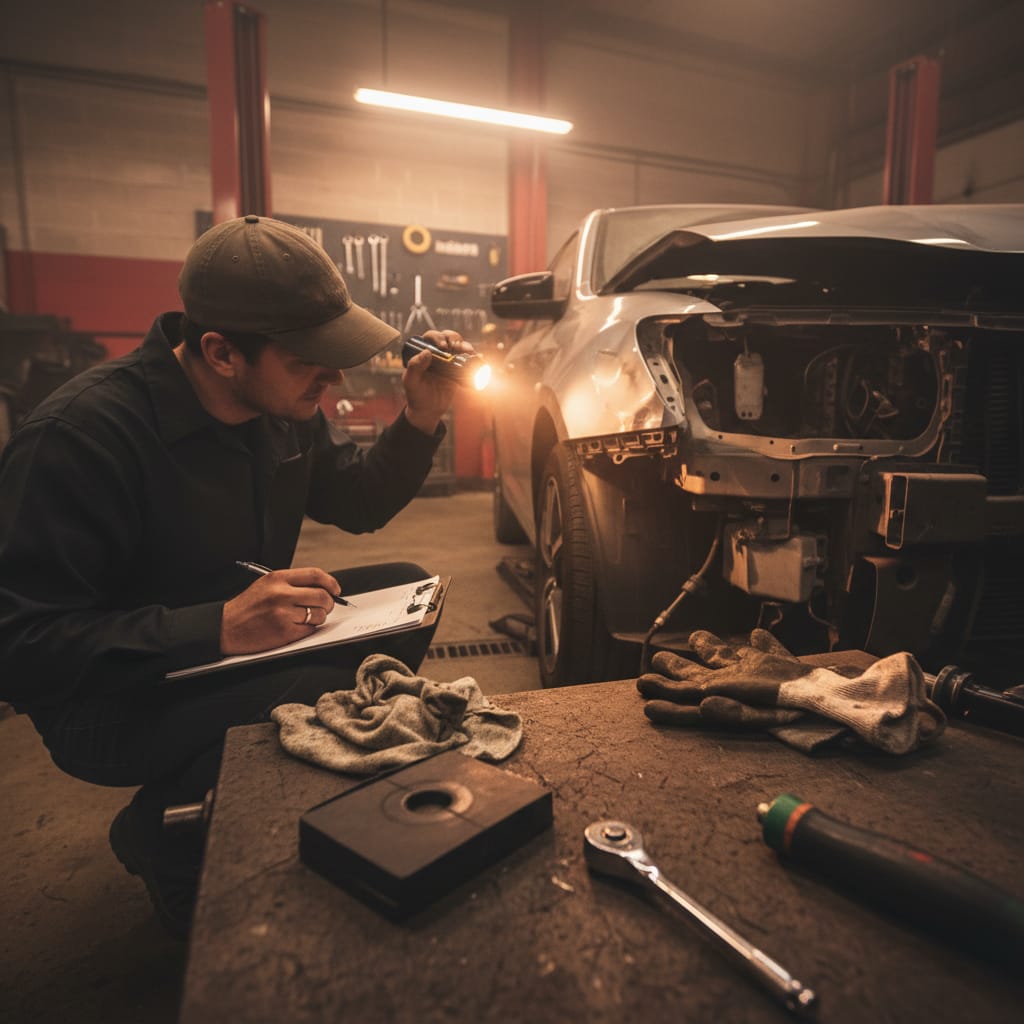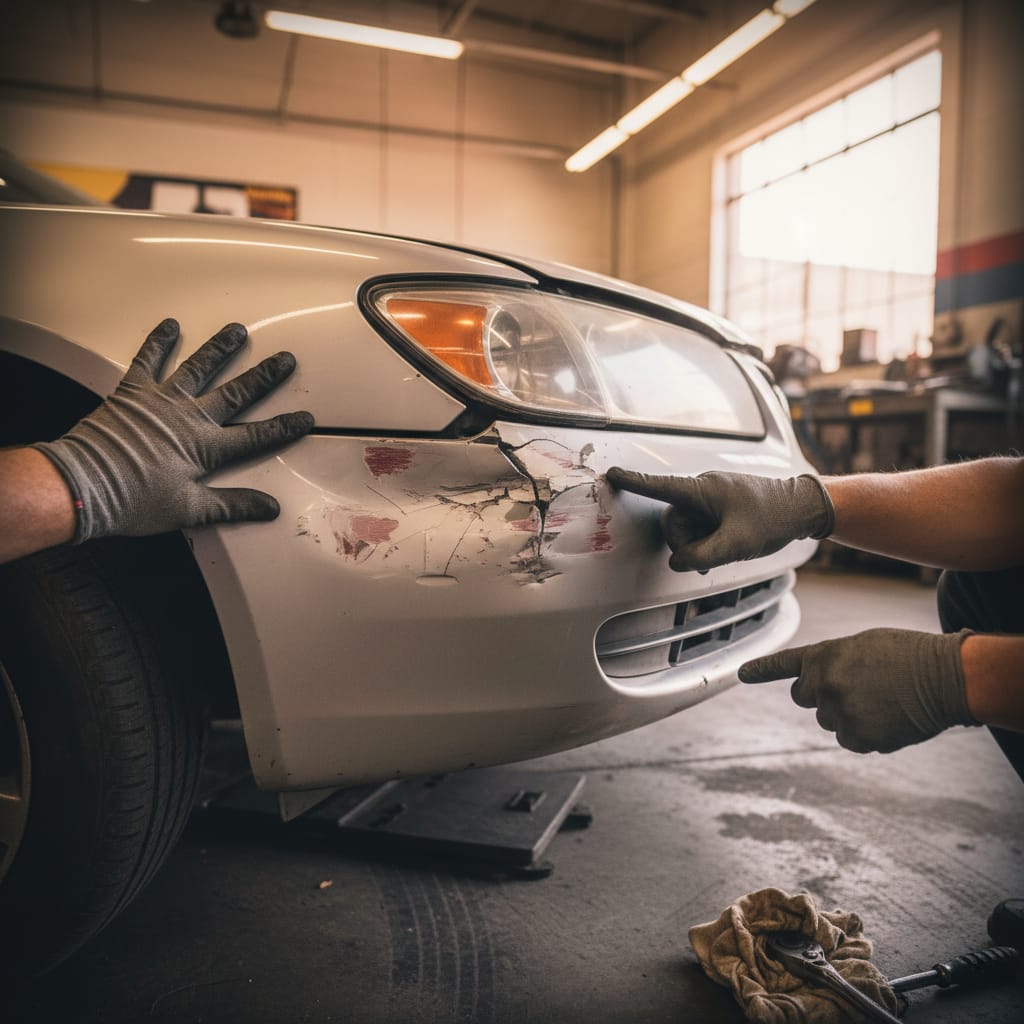
You back out of a spot at the Parkway Plaza shopping center, hear a soft crunch, and find a dent on your rear fender the size of a grapefruit. The paint looks okay. Nothing is dangling. You drive home thinking it is mostly cosmetic.
Maybe it is. Maybe it is not.
That is the problem with fender benders. The term sounds minor. But "fender bender" covers a wide range. It can be a scratch you touch up yourself, or a hit that quietly bends a panel support, kills a parking sensor, or shifts your headlight beam two inches to the left. In Spring Valley and across East County, we see this every week. A car comes in with what looks like a $400 dent and turns into a $1,200 repair once the panel comes off.
This guide explains what fender bender damage actually includes, when paintless dent repair works, what hides behind sheet metal, and how to make a smart call on insurance. By the end, you will know what you are dealing with and what to ask a shop before you hand over your keys.
Section 1: What "Fender Bender" Damage Actually Includes
The word "fender" is specific. It is the metal panel that wraps around each wheel well. But in everyday conversation, "fender bender" means any low-speed collision, and the damage can spread far past the fender itself.
Here is the actual spectrum:
Cosmetic damage only. A small ding with no paint break, a light scuff on a bumper cover, or a shallow crease on a flat panel section. No structural deformation. This is the best-case scenario.
Panel damage with paint compromise. The dent is deeper, paint is cracked or chipped, and bare metal or primer is exposed. Rust starts forming in exposed metal within weeks in San Diego County's salty coastal air. You cannot leave this alone long-term.
Bumper cover damage. The plastic bumper cover (front or rear) is the most commonly hit part in low-speed collisions. It looks structural but it is not. Manufacturers make it from flexible thermoplastic. It can crack, crease, or pop off its clips. Behind it sits a steel reinforcement bar and, in most modern vehicles, a crash sensor or parking system component.
Hood or headlight involvement. A front-end bump can bow a hood at the leading edge or crack the headlight housing. Even a hairline crack in a headlight lens lets moisture in. The lens fogs and the light output drops. That is a safety issue, not just a cosmetic one.
Structural damage. Rare in true low-speed hits, but it happens. If the bumper hit at a sharp angle, or if the car was already repaired once before, the force can travel into the fender support, the inner fender liner, or the A-pillar base. Once structure moves, you need frame measurement, not just dent repair.
The repair approach depends entirely on where you fall in that spectrum. A shop cannot tell you which category you are in by looking at the outside of the car. The panel needs to come off.
Section 2: PDR vs. Traditional Bodywork — Which One You Need
This is the question most drivers ask first. The answer turns on one thing: is the paint still intact?
Paintless Dent Repair (PDR)
PDR uses metal rods and specialized tools to push or pull a dent from behind the panel. No filler, no primer, no paint. A skilled technician can restore a dent to factory shape without touching the finish.
PDR works when:
- The paint over the dent is unbroken and not cracked
- The metal has not been stretched beyond its elastic limit
- The dent has no sharp creases (creases thin the metal and can make PDR impossible)
- You can access the back side of the panel
When all four conditions are true, PDR is faster, less expensive, and produces a cleaner result than traditional bodywork. There is no color-matching risk, no texture difference, and no chance of overspray on nearby trim.
Traditional Bodywork
Traditional bodywork is the right choice when:
- The paint is cracked, chipped, or missing over the damage
- The metal has a sharp crease that will not push back cleanly
- The dent is near a panel edge or body line (edges do not flex)
- The panel has been previously repaired with filler
Traditional repair means metal straightening, body filler to correct minor surface imperfections, primer, paint matched to your car's paint code, and clear coat. Done correctly, you cannot see the repair. Done poorly, you will see it in six months when the paint starts to peel or the color does not quite match.
At All Auto Repair, we use factory paint codes and two-stage paint matching equipment. Every car has a paint code on a sticker, usually inside the driver's door jamb. We pull that code before we ever open a paint gun.
The short version: PDR when the paint is intact. Traditional bodywork when it is not. A shop telling you PDR is fine on cracked paint is cutting a corner.
Section 3: Hidden Damage in Low-Speed Collisions
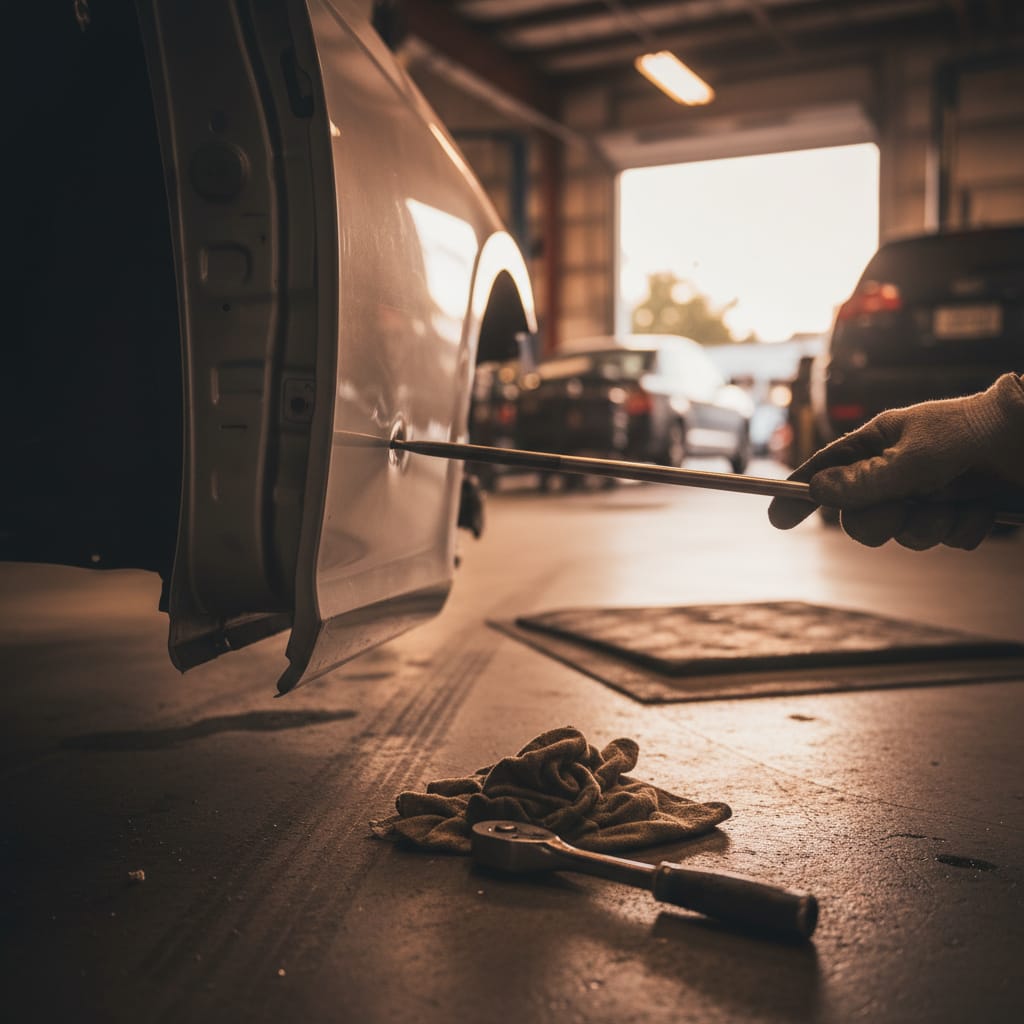
A 10-mph parking lot hit does not feel like much. But modern cars pack a lot of technology into the space behind bumper covers and beneath body panels. Low-speed hits regularly knock out components you cannot see without disassembly.
Here is what gets missed most often:
Parking sensors and cameras. Most vehicles built after 2018 have ultrasonic parking sensors embedded in the bumper cover. A rear-end tap that dents the cover can crack the sensor housing or push it out of alignment. The sensor still powers on. It still beeps. But the detection range is off, or it false-triggers. You do not know until you almost back into something. As of 2018, NHTSA requires rearview cameras on all new passenger vehicles. If your camera mount shifted, that is a safety system, not just a convenience feature.
Headlight alignment. A front-end bump can push the headlight housing back into its mount, rotating the beam. The light still turns on. But instead of lighting the road 150 feet ahead, it points 20 feet down or slightly left. You do not notice until you drive at night and realize the road looks different. Misaligned headlights are also a California fix-it citation.
ADAS sensors. ADAS stands for Advanced Driver Assistance Systems. These are radar, lidar, or camera units that feed lane-keep assist, automatic emergency braking, and adaptive cruise control. They are calibrated to within fractions of a degree. A bumper replacement or repaint that moves one by 2mm can throw off the whole system. The car will drive fine, but the safety assist features will not work correctly. Recalibration requires a scan tool and a calibration target.
Crumple zone compression. Crumple zones are sections of the vehicle's structure built to absorb crash energy by deforming in a controlled way. Once they compress, even slightly, they are no longer full strength. A bumper reinforcement bar that took a hit and was straightened (rather than replaced) is weaker the second time around.
The rule is simple: if the car took any hit hard enough to dent sheet metal, it needs a full inspection. Not just a look at the outside.
Section 4: Insurance vs. Paying Out of Pocket
This is the question drivers in Spring Valley and La Mesa ask us most. Whether to file a claim depends on three numbers: the repair cost, your deductible, and your rate history.
When to file a claim
File when the repair cost is significantly higher than your deductible. If a fender repair runs $1,800 and your deductible is $500, the insurance covers $1,300 of real cost. That math is straightforward.
Also file when the other driver was at fault and their insurance covers it. Your rates do not rise on a not-at-fault claim in California. The other driver's carrier pays, and you are made whole.
When to pay out of pocket
Pay out of pocket when the damage is minor and the estimate is close to your deductible. If your deductible is $1,000 and the repair is $950, filing a claim gains you nothing. Worse, the claim goes on your record and your rates may increase at renewal. Most carriers in California review your claim history when they reprice your policy.
The rule of thumb: if the repair is less than your deductible plus one year of projected rate increase, just pay it yourself.
California rights on insurance claims
Under California Insurance Code 758.5, you have the right to choose your own repair shop. An insurance company cannot legally require you to use a specific shop or a direct-repair-program shop. Your insurer can recommend a shop. You do not have to go.
You also have the right to a written estimate before work starts, the right to OEM or quality aftermarket parts depending on your policy, and the right to a rental car if your policy includes it. The California Department of Insurance publishes consumer rights guides at insurance.ca.gov if you need to reference them.
If an adjuster tries to low-ball the estimate or steer you to a shop you do not trust, you can get your own estimate from a California BAR-licensed shop and submit it to your carrier.
Section 5: How the Repair Works at All Auto Repair
We have been doing this work in Spring Valley since 1989. The repair process is the same whether the car is a 2006 Civic or a 2023 Silverado. Here is exactly what happens when you bring a fender bender to us.
Step 1: Tear down. We remove the damaged panel, bumper cover, or trim piece, whatever is needed to see the full scope. Photos get taken before anything is touched. This is your documentation and the shop's documentation.
Step 2: Document. We identify every damaged component: sheet metal, clips, brackets, sensor mounts, wiring, paint condition. If you are filing an insurance claim, this document goes to your adjuster. Nothing is hidden or minimized.
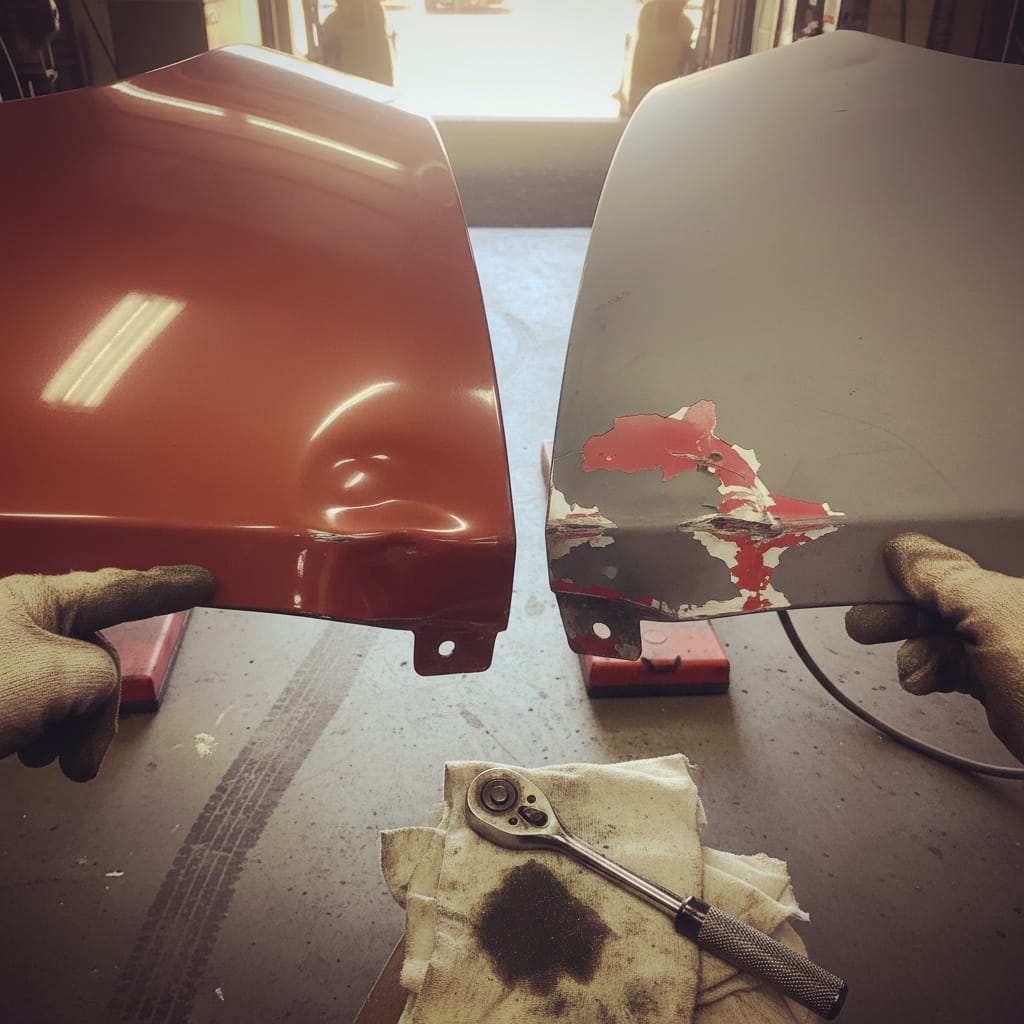
Step 3: Repair or replace. If the panel can be straightened and hold a quality repair, we straighten it. If it is too far gone (creased past the metal's yield point, or structurally weakened) we replace it. We do not fill over bad metal and call it done.
Step 4: Paint. We match your paint code. Every vehicle has one, usually a sticker inside the driver's door jamb. Two-stage paint (base coat plus clear coat) gets applied in our paint booth. The clear coat cures before the car moves.
Step 5: Reassemble. All panels, clips, sensors, and trim go back in. Sensor functionality gets tested. Headlight aim is checked. Nothing goes back on the car unchecked.
Step 6: Quality check. We walk the car in natural light before calling you. Panel gaps, paint blend, sensor function, door operation. All of it gets reviewed. If something is not right, we fix it before you see the car.
Most fender bender repairs take one to three days. If we are waiting on a painted OEM panel from a supplier, it can run four to five days. We will tell you the honest timeline upfront.
Drivers come to us from across the area: Spring Valley, Lemon Grove, El Cajon, Santee, and down Sweetwater Road from Chula Vista. The work is the same quality no matter where you live.
FAQ: Fender Bender Repair in Spring Valley
Does a fender bender affect my car's resale value?
Yes, if it is not repaired properly or not repaired at all. Any accident that shows on a CARFAX or AutoCheck report will reduce what a buyer is willing to pay, often by more than the repair would have cost. A quality repair documented with photos and receipts reduces that hit. Some buyers will still discount the car, but a clean repair is always better than visible damage or a sloppy patch job.
How long does fender bender repair take?
Most jobs run one to three business days. Simple PDR on a small dent with intact paint can be done same day or next day. A fender replacement with painting takes two to three days because paint needs to cure before the panel goes back on the car. If the job involves a special-order part or color-match on a rare paint code, plan for four to five days. We give you a timeline estimate before work starts.
Can I drive the car with fender damage?
Usually yes, as long as nothing is dragging, no lights are broken, and the wheel well clearance is not affected. But "drivable" does not mean "leave it." Exposed metal rusts quickly, even in the dry San Diego County climate. Surface rust can appear within weeks. And if a sensor or headlight was affected, driving at night with a compromised safety system is a real risk.
Will my insurance rates go up after a fender bender claim?
In California, a not-at-fault claim should not raise your rates, though insurance companies can factor in your claim frequency at renewal. An at-fault claim where you hit something, or were found partially at fault, can raise your rate. The increase varies by carrier and your existing history. If the repair is close to your deductible, paying out of pocket keeps the claim off your record entirely.
What is the difference between a dent and a crease?
A dent is a rounded depression in the metal. The surrounding panel is still intact and the metal kept its shape around the impact point. A crease is a sharp fold or line in the metal where the panel was bent past its elastic limit. Dents are better candidates for PDR. Creases are harder because the metal has been thinned at the fold line. Pushing it back can cause micro-fractures or leave a visible line. Creased panels often need traditional bodywork or replacement.
Ready to Get Your Car Looking Right Again?
All Auto Repair & Auto Glass has been part of San Diego County since 1989. Family-owned, honest, and standing behind every job we do. Call or text Sam at (619) 466-3296 whenever you're ready.
We are at 628 Grand Ave, Spring Valley, CA 91977. Most fender bender estimates take 30 minutes or less. We photograph the damage, walk you through what it needs, and give you an honest number, before you commit to anything.
Learn more about All Auto Repair's fender bender repair page or explore our full collision repair services.