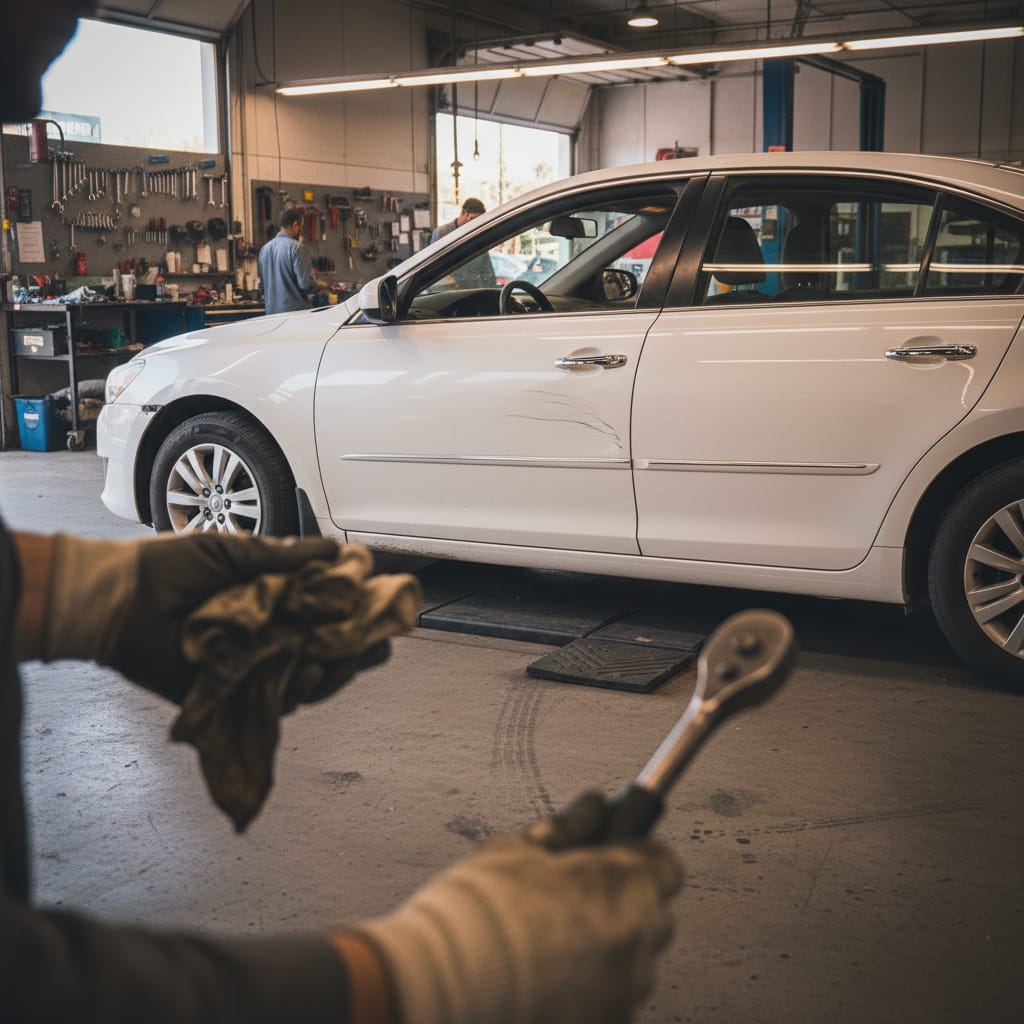
You are merging onto the freeway near Spring Valley and another car drifts into your lane. The contact lasts only a second. But when you pull over and look, there is a long scrape running from your front door all the way to your rear quarter panel. It looks like paint damage. You wonder if a detail shop can buff it out.
Sometimes they can. More often, they cannot. Sideswipe collision repair Spring Valley CA is trickier than it looks because a sideswipe spreads force across multiple panels at once. Understanding what actually happened to your car helps you make a smarter repair decision.
We have been fixing sideswipe damage at 628 Grand Ave in Spring Valley since 1989. This guide walks you through how a sideswipe works, which panels get hit, why the rocker panel changes everything, and how to handle the insurance side.
What a Sideswipe Actually Does to the Panels
A sideswipe happens when one vehicle makes glancing contact along the side of another. The two cars are moving in the same direction or crossing paths at a shallow angle. The contact is not a direct hit. It is a scraping force that travels horizontally across the car's side.
That scraping motion is what makes sideswipe damage different from a standard collision. A direct rear hit concentrates force on one spot. A sideswipe spreads force across whatever panels the other car touched on its way past.
Three scenarios cause most sideswipes in the Spring Valley area:
- A lane merge on the 94 or Interstate 8 where someone drifts without checking mirrors
- A tight parking structure where a passing car clips your side
- A narrow street or alley where someone passes too close
In each case, the contact point moves. The other vehicle or object is not stationary. It slides along your car's surface. That sliding action creates both paint damage and panel deformation, often at the same time and across several panels.
Which Panels Get Hit and Why It Matters
The side of a car is not one panel. It is a row of separate pieces. From front to back, a typical four-door sedan has:
- Front fender (the metal between the front wheel well and the front door)
- Front door
- Rear door
- Rear quarter panel (from the rear door opening back to the trunk)
A short sideswipe may only clip the front door. A full-length contact can touch all four panels in a single pass. The total number of panels involved is the first thing that drives repair cost and time.
Why does panel count matter so much? Each panel is a separate piece of metal. Each one that is dented or scraped needs its own repair work. Each one needs to be primed and painted. And because car paint shifts in color over time, each painted panel needs to blend into the adjacent one. More panels mean more blending steps.
There is also a practical issue with multi-panel damage: the repairs have to be sequenced correctly. You cannot paint the front door before the adjacent fender is straightened. The work on each panel affects the fit and finish of the ones next to it.
Rubber trim molding runs along the lower edge of most car doors. In a sideswipe, this trim is often the first thing that gets ripped off or creased. Trim replacement sounds minor, but clips break, panels need to be stripped down to install new molding, and the color has to match. It adds time to the job.
Sideswipes also frequently clip the side mirror. A mirror hit hard enough gets folded back, cracked, or completely torn off. The mirror is not just cosmetic. It is a safety item. California law requires functioning mirrors. A ripped-off mirror needs to be replaced before you drive the car.
The Rocker Panel: Why It Changes Everything
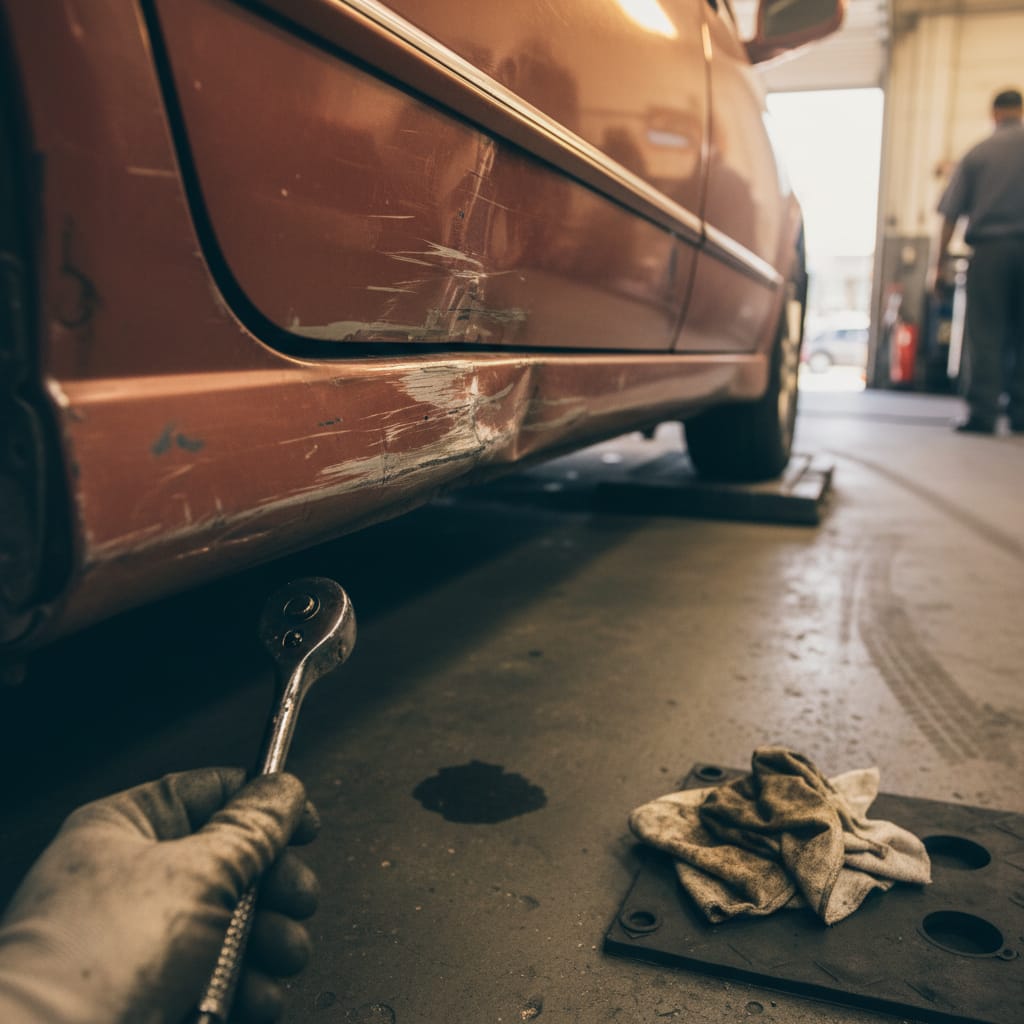
The rocker panel is the structural section that runs along the bottom of the car, between the front and rear wheel wells. It sits below the doors, at the base of the car's body.
Most drivers do not think about the rocker panel because it is low and not very visible. But it is one of the most important structural members in a modern unibody car. The rocker ties the front of the car to the rear. It carries load between the front and rear suspension mounting points. When the rocker is straight and intact, the car's body is rigid.
In a sideswipe, the rocker is in the direct path of whatever is scraping along the lower part of the car. A curb, a guardrail, or the lower edge of another vehicle can crease or buckle the rocker. When that happens, the repair scope changes significantly.
A creased rocker is not just a cosmetic problem. If the rocker is bent, the unibody may be out of alignment. Door gaps may not be even. Doors may not close properly. More importantly, the car's structural rigidity is compromised. In a future accident, a damaged rocker means less protection for the occupants.
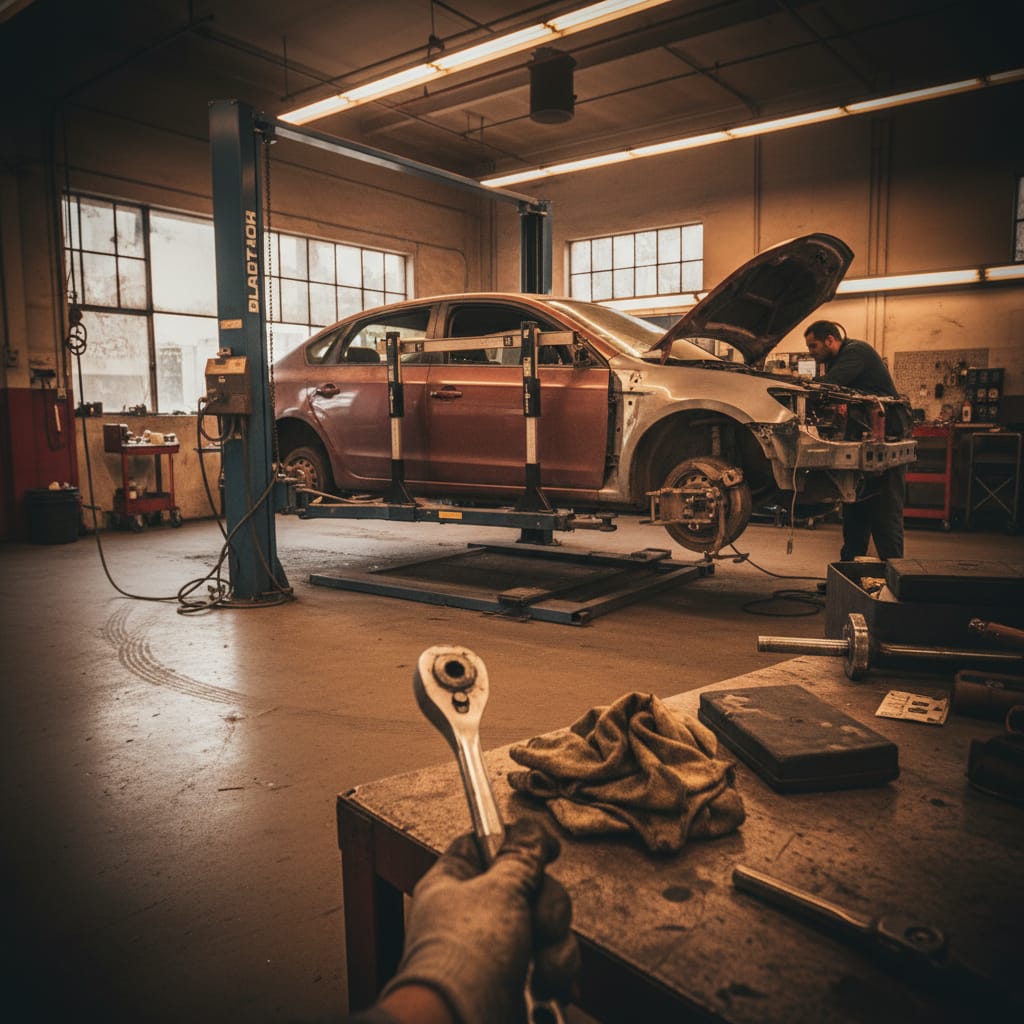
Repairing rocker damage always requires frame machine measurement. A frame machine is a hydraulic straightening bench with a computerized measuring system. The tech attaches the car to the machine and measures dozens of points across the body. Those measurements are compared to the factory spec for that exact vehicle. Only then can the tech know whether the rocker is still in spec or whether it needs to be pulled back into position.
If the rocker is significantly damaged, it may need to be sectioned. Sectioning means cutting out the damaged portion and welding in new metal. This is skilled work that follows manufacturer repair procedures. A shop that skips the frame measurement and just covers up rocker damage with filler is leaving you with a structurally unsafe car.
Paint Damage vs. Panel Deformation
Not every sideswipe dents the metal. Some contacts are light enough that the damage is only to the paint. A light guardrail scrape or a glancing contact from a slow-moving car may leave scuff marks, transfer paint from the other object, or scratch through the clear coat without bending anything.
When the damage is only paint-deep, repair options are simpler. Light scratches through the clear coat can sometimes be corrected by wet sanding and polishing. Deeper scratches that cut into the base coat or primer need to be re-sprayed. In either case, the panel underneath is undamaged.
The problem is that it is not always obvious which type of damage you have just by looking. A long, light-looking scrape can hide shallow panel deformation underneath. The metal can be pushed in just enough to be visible under proper lighting but easy to miss in a parking lot. This is why a proper estimate requires the shop to inspect the panels under good lighting and, in many cases, to feel the surface by hand.
Panel deformation means the metal itself has moved. Even a small amount of deformation usually cannot be polished away. The metal needs to be worked back into shape before any paint is applied.
Multi-Panel Repair and Paint Blending
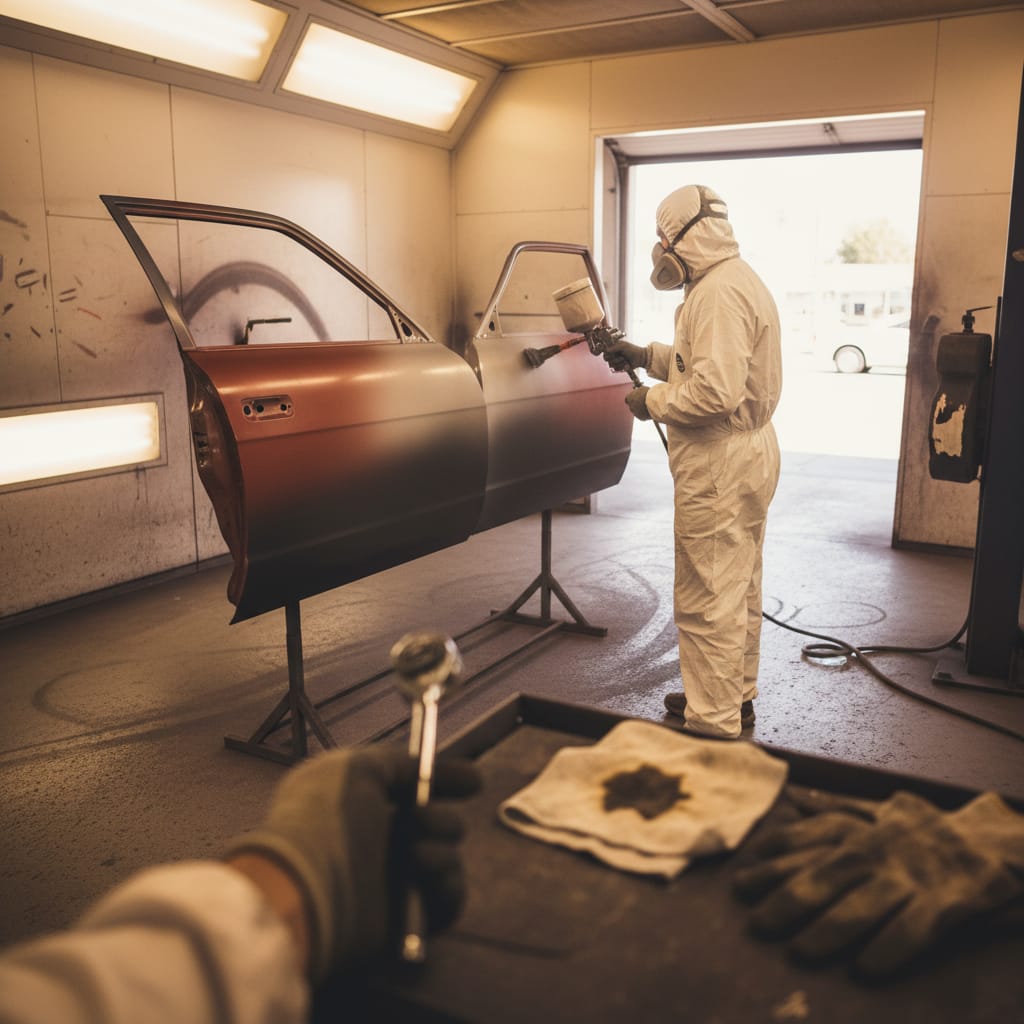
Paint matching surprises most customers. You might expect a freshly painted door to match the one next to it. In reality, car paint fades over years of sun exposure. A new paint job on one panel will not match the sun-faded panels beside it unless the shop blends the new color into the adjacent ones.
Blending means the painter sprays a light coat of the new color onto the edge of the neighboring panel and fades it out. This creates a transition that is invisible to the eye.
For a four-panel sideswipe, a good paint job may require blending on five or six panels. The front fender blends into the hood. The quarter panel blends into the trunk lid. Each blend adds time and material cost.
This is why sideswipe collision repair Spring Valley CA estimates can run higher than customers expect for what looks like a scrape. The visible damage is just the start. The blending work is what makes the repair invisible.
Insurance for Sideswipe Damage
Insurance coverage for a sideswipe depends on who caused it.
If another driver sideswiped you and it was their fault, their liability coverage should pay for your repairs. You file a claim against their insurance, not yours. In California, a not-at-fault claim should not raise your rates.
If you sideswiped something, like a guardrail or a parked car, that is an at-fault claim. It goes through your collision coverage, and your deductible applies.
Under California Insurance Code Section 758.5, you have the right to choose your own repair shop. Your insurance company cannot require you to use their preferred shop. They can recommend shops, but the final choice is yours.
If an insurer writes a low estimate, you are not required to accept it. The shop can document additional damage and send a supplement. For more on your rights, the California Department of Insurance has consumer guides.
You can also read our related article on frame damage repair in Spring Valley CA if the sideswipe was severe enough to raise structural concerns.
Our collision repair page covers the full range of services we offer for sideswipe and other collision damage.
FAQ
Can a sideswipe damage be fixed with just paint and no bodywork?
Only if the contact was very light and the metal underneath is completely undamaged. Most sideswipes that run across multiple panels will have at least some panel deformation, even if it is subtle. A proper inspection is the only way to know.
How long does sideswipe collision repair take?
A single-panel sideswipe with light damage might take two to three days. A full-length four-panel sideswipe with rocker damage and a mirror replacement can take a week or more. The frame measurement, panel work, and paint blending all take time to do correctly.
Does every sideswipe need a frame machine check?
Not always. If the damage is clearly limited to the upper panels and the rocker shows no signs of impact, a frame check may not be needed. But if the rocker panel is in the damage zone, a frame measurement is required to verify the unibody is still in spec.
Will my insurance cover sideswipe repairs?
If another driver caused the sideswipe, their liability coverage should pay. If you caused it, your collision coverage applies. Either way, California law gives you the right to choose your own shop.
What if the other driver drove off after the sideswipe?
This is a hit-and-run. You would file under your own uninsured motorist property damage coverage, if you have it, or your collision coverage. Document the damage with photos right away and file a police report. This helps with your claim.
Can the rubber door trim be replaced without repainting the door?
In some cases, yes, if the molding is the only item damaged and the paint under it is not scratched. But if the impact scraped paint under the molding line, the door will need paint work too.
Ready to Get a Straight Answer on Your Repair?
Sideswipe damage looks like just a scrape, but the real scope depends on how many panels were hit and whether the rocker panel took a blow. The only way to know for sure is a proper inspection under good lighting with the car on flat ground.
We have been doing this work in Spring Valley since 1989. We will tell you exactly what happened to your car, what it takes to fix it right, and what your insurance should cover. No pressure. No guessing.
Call or text Sam at (619) 466-3296 whenever you are ready. We are at 628 Grand Ave, Spring Valley, CA 91977.